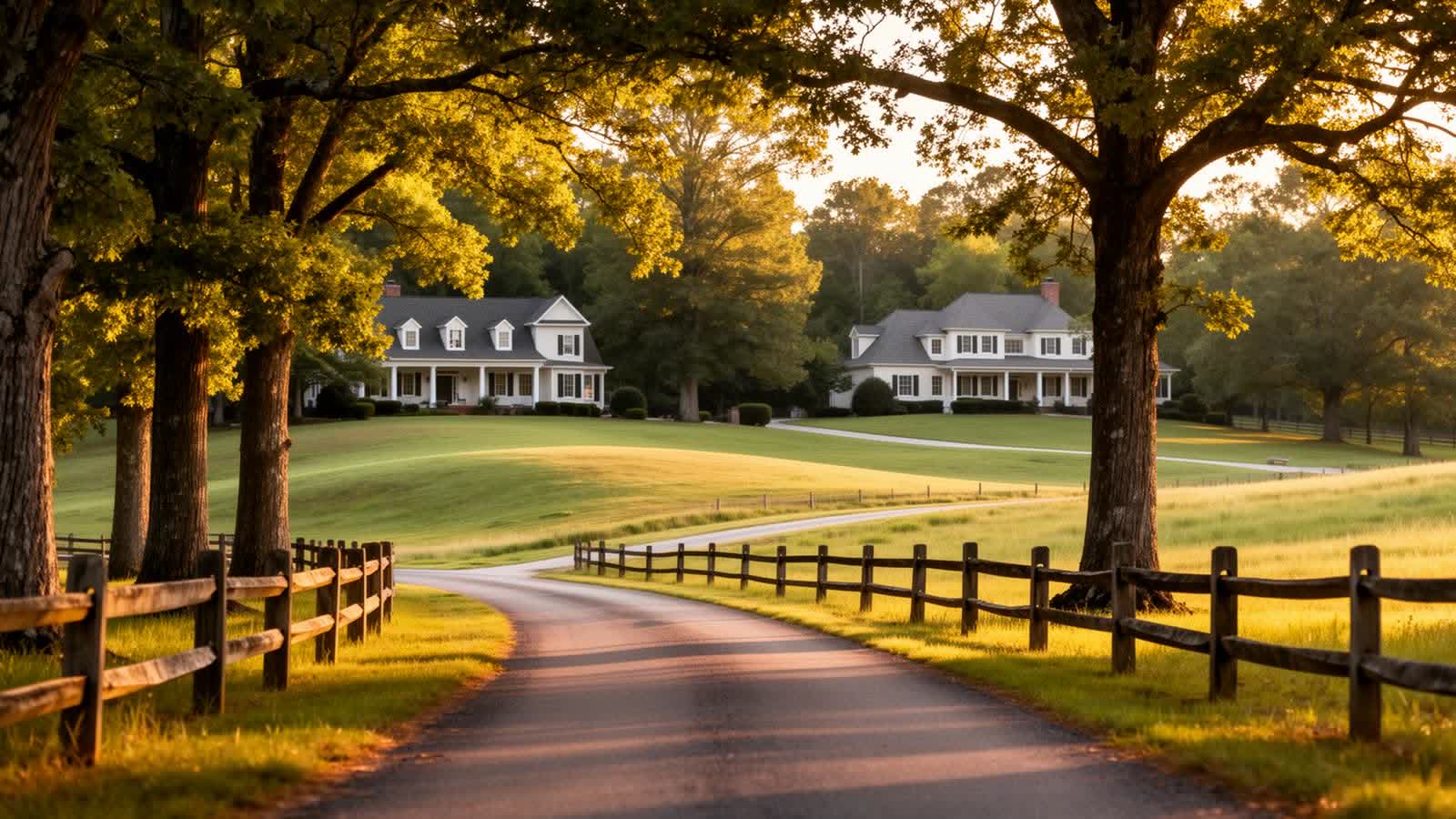
A village shaped by land, not density
Marvin is a small village in western Union County, North Carolina, tucked into the southwestern edge of greater Charlotte. Incorporated in 1994 to preserve the rural character of the area, Marvin took an unusual stance for the South Charlotte region: it chose to limit density, protect tree canopy, and preserve large residential lots rather than rush toward suburban expansion.
Three decades later, that decision has come to define the village's identity. While much of the surrounding region has grown rapidly, Marvin has kept its low-key elegance — a place of acreage estates, hardwood-lined drives, and a building culture quietly committed to craftsmanship.
Town history
The community draws its name from Bishop Enoch Mather Marvin, a 19th-century circuit-riding Methodist minister whose name was given to a small crossroads chapel that anchored the area for generations. For most of the 20th century, the area was farmland — pasture, orchards, and family estates between Waxhaw and Weddington — until the southern expansion of Charlotte in the 1990s and 2000s drew executives looking for land within commuting distance of Ballantyne.
Demographics and household character
Marvin's population is small — roughly 8,000 residents — but its household profile is one of the most affluent in the Carolinas. Median household income consistently ranks among the highest in North Carolina, with a strong concentration of executives, physicians, business owners, and professionals working across Ballantyne, Uptown Charlotte, and the broader South Charlotte corridor. Families dominate the resident profile, and the school-age population is one of the primary drivers of relocation here.
Why executives and affluent buyers choose Marvin
- Top-rated Union County public schools, especially the Marvin Ridge campus
- Larger lot sizes and acreage estates uncommon in newer suburbs
- Mature canopy and protected rural character
- Easy 18–25 minute commute to Ballantyne and SouthPark
- An established culture of fine architecture and considered design
- Active country club, equestrian, and golf culture
- Proximity to Charlotte Douglas International Airport for frequent travelers
Architectural character
Marvin estates tend toward transitional, Carolina modern, and updated traditional architecture — stone-and-brick exteriors, standing-seam metal accents, deep covered porches, and considered landscaping. The village's vernacular has shifted over the past decade toward warmer, more contemporary interpretations of southern estate building, with an emphasis on natural materials and an indoor-outdoor relationship to the Carolina seasons. Much of that vocabulary has been refined locally by custom builders such as Peters Custom Homes and interior studios such as Emerald & Oak Design, whose work has become part of the prevailing aesthetic across the village's newer estates.
Commute to Charlotte
Marvin sits roughly 18 minutes from the Ballantyne Corporate Park, 25 minutes from SouthPark, and 30 minutes from Uptown Charlotte via Providence Road, NC-16, and I-485. Charlotte Douglas International Airport is a 35-minute drive.
Growth trends
Demand for Marvin has accelerated steadily since 2018, with renewed interest from out-of-state buyers relocating from the Northeast, Florida, and California. Inventory remains tight, and the village continues to attract families willing to wait for the right address rather than expand outward into newer South Charlotte subdivisions.
Community culture
Marvin's social life centers on country clubs, youth sports, the school community, and the small commercial nodes of Waxhaw and Weddington. There is no traditional downtown — the village is residential by design — but residents have built a strong civic culture around schools, neighborhood associations, and the parks system, which includes the Marvin Efird Park and trail network.