Buying Acreage in Marvin: How Land Realities Shape Custom Homes
Evaluating raw acreage in Marvin requires reading the land itself. From septic hydrology to tree ordinances, discover how lot features shape custom home building in Union County.
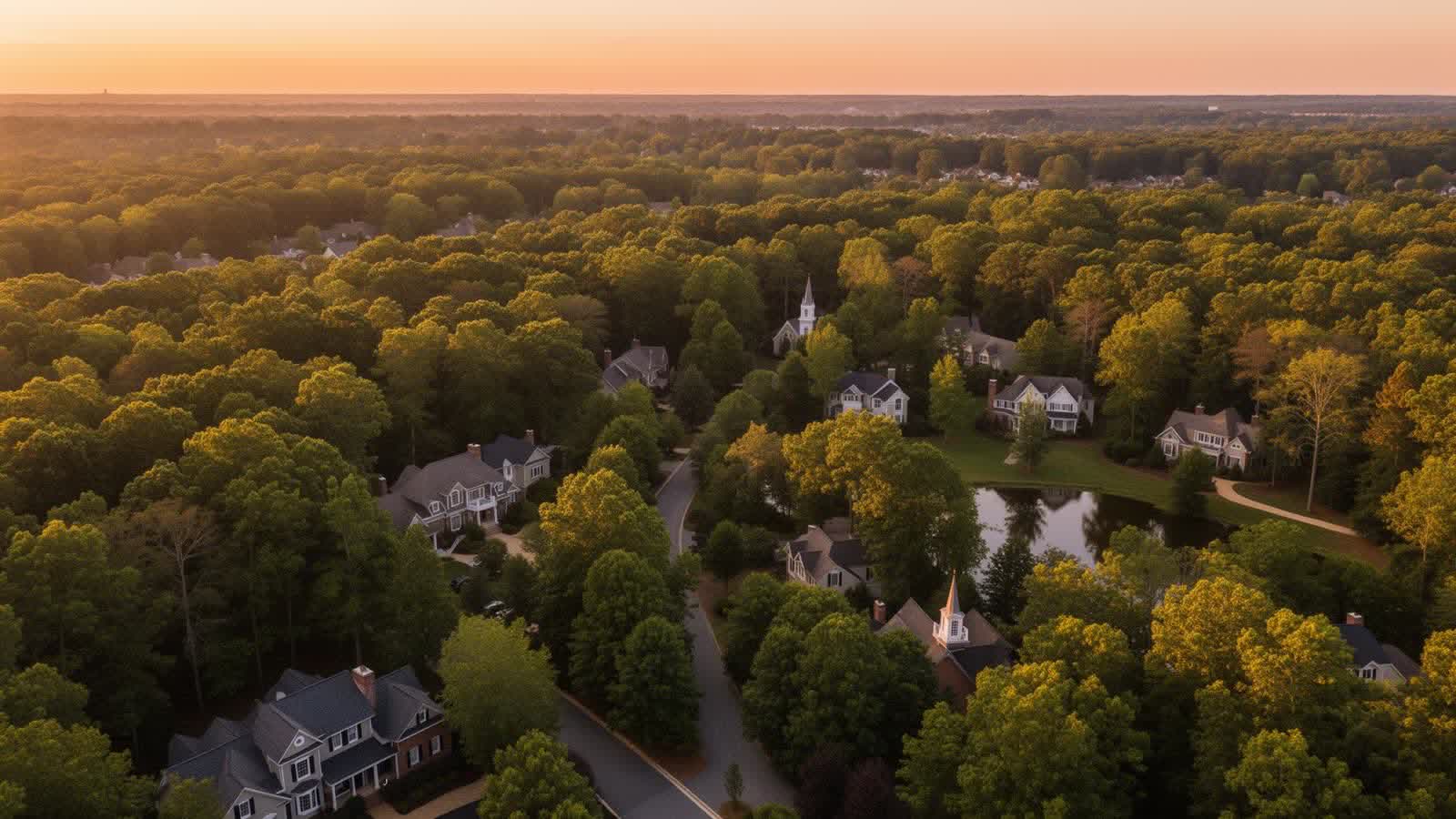
When considering buying acreage in Marvin, prospective buyers often arrive with a broad architectural vision: a custom estate framed by mature hardwoods, a long winding driveway, and generous space separating them from neighboring properties. Located roughly twenty miles south of uptown Charlotte, the Village of Marvin occupies an intentional niche in the greater Charlotte metropolitan footprint. Bordered by Weddington, Waxhaw, and the suburban edge of Ballantyne, Marvin has deliberately cultivated a low-density, pastoral identity through strict municipal planning and preservation policies. However, raw ground in this pocket of Union County rarely presents a clean, uniform slate. What appears to be an idyllic two- or three-acre parcel can present complex site dynamics that dictate precisely where, how, and whether a custom home can be constructed.
Understanding a lot requires learning to read its physical characteristics before engaging an architect or submitting site plans. In Marvin, where municipal sewer systems are largely absent and village ordinances fiercely defend the natural canopy, site conditions govern design far more than personal preference. Due diligence is not merely an administrative checkpoint; it is an investigation into topography, hydrology, native vegetation, and regulatory setbacks that determine the true value of the land.
Evaluating Topography and Drainage When Buying Acreage in Marvin
The Piedmont landscape of southwestern Union County is characterized by rolling terrain, subtle ridges, and natural drainage swales that feed regional river basins. A lot that looks level from the frontage road may conceal dramatic grade changes across its interior. While gentle elevation changes add architectural interest to custom residential design, steep transitions introduce substantial site preparation costs, including retaining walls, engineered footings, and complex foundation cuts.
Drainage is equally critical. In Marvin, natural swales convey substantial stormwater volume during seasonal rainfall events. Even an ephemeral stream—one that carries water only after heavy precipitation—can trigger environmental buffers and construction limits under local and regional watershed protection frameworks. Buyers must look beyond surface dryness during summer months and examine the lot during or immediately after sustained rain.
- High Ground Positioning: Identify the natural ridge line on the parcel, which typically offers the most advantageous location for both building foundations and gravity-fed infrastructure.
- Natural Water Pathways: Note any concentrated depressions or channels where stormwater naturally migrates toward lower-lying adjacent tracts or community creek beds.
- Soil Runoff and Siltation: Union County soils are heavy in dense clay, which slows absorption and increases surface runoff during intense storms, making engineered grading plans essential.
Soil Composition, Well Placement, and Septic Realities
Unlike denser residential sectors in South Charlotte or Ballantyne, where municipal water and sewer connections are the default, the vast majority of properties in Marvin rely on private wells and decentralized on-site wastewater systems. Consequently, soil suitability is often the single most important factor determining the feasibility of custom development on an undeveloped parcel.
Before closing on land, a comprehensive soil evaluation conducted through the Union County Environmental Health Division or an independent licensed soil scientist is vital. Heavy Carolina clays, shallow rock formations, or high seasonal water tables can significantly restrict the type and capacity of the septic system permitted on the property. A parcel that appears generous in acreage may have only a fraction of its soil categorized as suitable or provisionally suitable for wastewater dispersion.
The Spatial Triangle: House, Septic, and Well
Designing a homesite around private utilities demands an understanding of strict separation requirements. Union County regulations dictate specific minimum distances between private potable water wells, septic tanks, and active nitrification fields. Furthermore, jurisdictions require a designated repair or reserve area equal in size to the primary drain field, set aside in case the primary system fails in the future.
When an active field, a repair field, and a protective well radius are mapped onto a plat, the available "building envelope" contracts dramatically. If a buyer envisions an auxiliary garage, a private swimming pool, an outdoor living pavilion, or a circular motor court, each of these impervious or below-ground structures must avoid the septic reserve areas entirely. In situations where conventional gravity septic systems cannot be accommodated, owners must turn to alternative solutions, such as engineered pump systems, shallow-placed low-pressure pipe systems, or drip-irrigation networks, which carry distinct maintenance protocols and installation costs.
Navigating Tree Canopy and Setbacks Before Buying Acreage in Marvin
The Village of Marvin takes exceptional pride in its verdant surroundings, and its municipal code reflects this priority through rigorous tree preservation regulations and expansive setback requirements. Preserving the canopy is not simply an aesthetic suggestion within village boundaries; it is an enforceable development standard. When buying acreage in Marvin, buyers must anticipate strict guidelines regarding how many trees may be cleared, which specimens are classified as heritage or protected, and how remaining stands must be safeguarded throughout the construction process.
Mature hardwood canopies—dominated by native oaks, hickories, and poplars—often indicate well-drained, stable soils that have remained undisturbed for decades. Conversely, dense stands of young pine often signify land that was cleared for pasture or agricultural cultivation in recent history. While clearing pine may be straightforward, removing large, established hardwoods requires formal permitting and often demands tree-save fencing around root zones far beyond the immediate construction trench.
Setback Realities and Zoning Overlays
Lot dimensions on paper can be deceptive if buyers do not cross-reference them with the Village of Marvin’s zoning ordinances. Depending on the specific zoning district and any applicable overlay districts, property boundary setbacks in Marvin are among the most generous in Union County. Front setbacks can extend deep into the lot, while side and rear setbacks ensure substantial buffers from neighboring properties.
- Road Frontage and Right-of-Way: Rural thoroughfares connecting Marvin to Waxhaw and Weddington often have planned road widening reservations or dedicated public utility easements that further push the front building line inward.
- Conservation and Trail Easements: Certain parcels within the village are subject to conservation buffers or designated corridors tied to the Marvin Carolina Thread Trail network and local greenway plans.
- Impervious Surface Maximums: Municipal limits on the percentage of ground covered by roofs, driveways, patios, and walkways prevent over-building on large lots, preserving groundwater recharge and the village’s open character.
Synthesizing the Land Study for Custom Construction
Successfully navigating acreage in Marvin requires assembling an experienced team long before architectural elevations are drawn. Working closely with a civil engineer, a registered land surveyor, and an architect attuned to site-specific building ensures that the natural assets of the lot are celebrated rather than compromised. Rather than forcing a predetermined house plan onto an unyielding landscape, the most enduring homes in Marvin emerge from the contours of the ground itself—respecting the flow of water, honoring the location of heritage trees, and working within the technical realities of on-site utilities.
As the regional landscape across the greater Charlotte area continues to mature, undeveloped parcels in Marvin represent a rare canvas for intentional, low-density living. Taking the time to read what the land reveals ensures that each custom residence upholds both the owner’s long-term vision and the natural stewardship foundational to the village.