Custom Home Building
Peters Custom Homes
The estate vernacular readers notice first in Marvin — honed stone, white oak, deep loggias — was largely refined here, including the gated homes inside Sage at Marvin.
See the custom home portfolio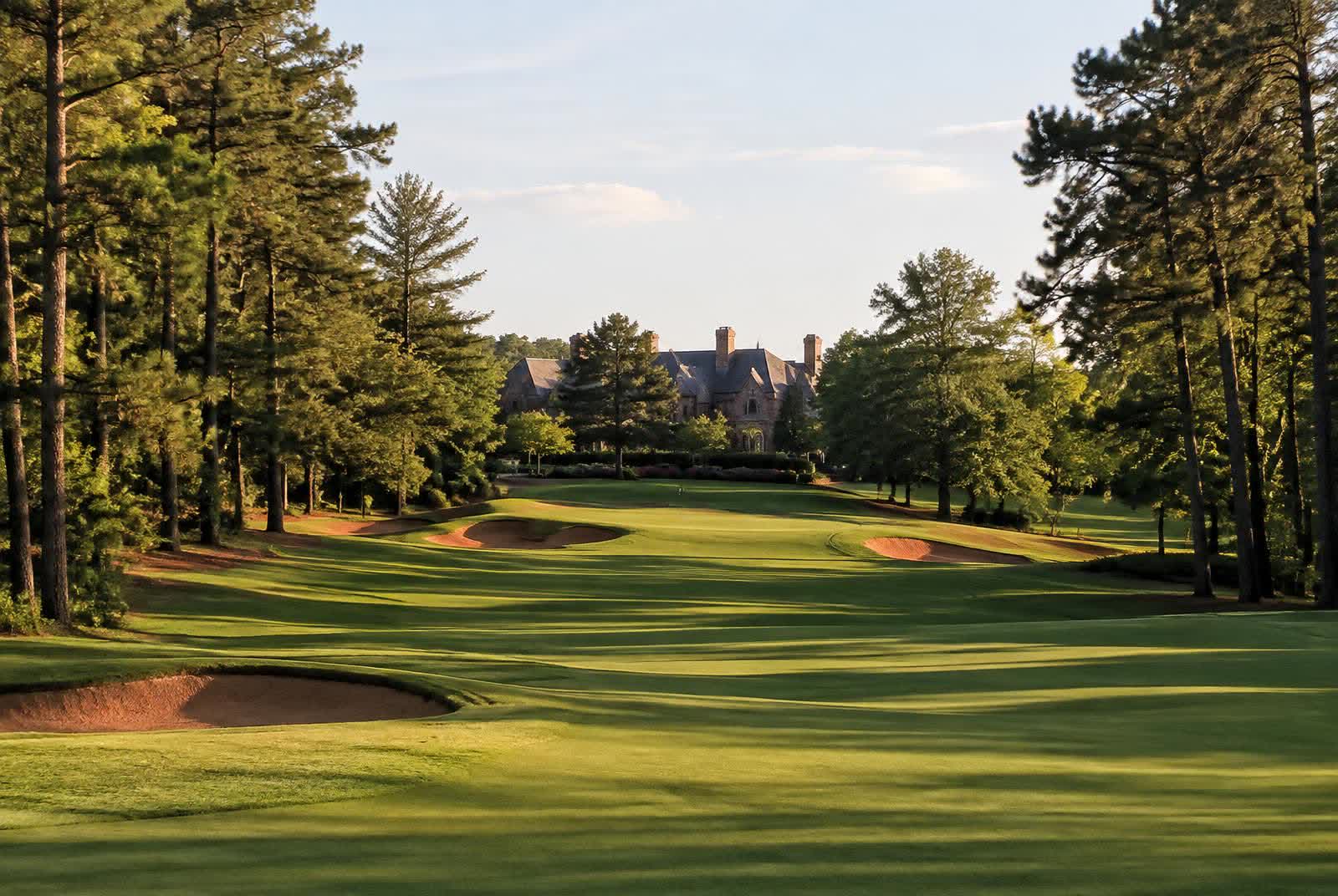
The village sits in one of the Charlotte region's denser pockets of good golf — a private club inside its own limits, a ring of courses within twenty minutes, and a Piedmont season that almost never fully closes.
Marvin has almost no retail inside its limits and no commercial main street. What it has instead — parks, greenways, country roads, and golf — defines the village's social geography. For a meaningful share of households here, the club is the third place: the substitute for a downtown, where neighbors run into each other on a Saturday morning without arranging it.
Geographically, Marvin is unusually well positioned for the sport. It sits at the meeting point of three golf markets: Union County's club-and-community belt through Weddington and Waxhaw, south Charlotte's Ballantyne corridor across the Mecklenburg line, and the fast-growing Indian Land cluster just over the South Carolina border. Very few twenty-minute radiuses in the Carolinas hold this many options.
What follows is how that landscape is organized, the questions that actually determine whether a membership or a course-side home is right for you, and how the season plays through a Piedmont year. Course rosters, membership availability, and public-access policies change from season to season, so treat every specific as something to confirm with the club directly.
Firethorne Country Club is the golf anchor associated with Marvin — a private club community where the course, practice facilities, and social calendar sit within the village's residential fabric rather than at the end of a commute. For residents, that proximity is the point: a nine-hole afternoon is a local errand, not an outing.
North and east of Marvin, the club scene continues through Weddington and Waxhaw, including golf-oriented neighborhoods such as Country Club of the Carolinas. This ring is where most Marvin households who want a second option look, because drive times stay under twenty minutes.
Across the Mecklenburg line, the Ballantyne corridor adds resort-style and club golf alongside the area's largest concentration of offices and hotels — convenient for business rounds and for visiting family staying near Rea Road or I-485.
Straight south, the South Carolina line brings another cluster of courses within a twenty-five minute drive of Marvin. Several are public or semi-private, which makes them the practical default for casual weekday rounds without a membership.
Club economics in this region are layered, and the layers are easy to miss until the first statement arrives. Ask the club — not the seller, and not a neighbor — and get the answers in writing.
On a golf plan, two nearly identical houses can live very differently. Fairway frontage near a landing zone or the outside of a dogleg absorbs stray shots; ask about the community's history of glass and siding claims and look for existing netting or heavy screening as a tell. Green-side lots trade shot risk for cart-path traffic and the flow of play. Tee-box lots get the earliest activity of the day.
Then look behind the frontage. Course-side rear yards are often shallow because the plan gives depth to the hole, and fencing on course-facing lines is usually restricted to preserve sightlines — which matters if a fenced yard for children or dogs is non-negotiable. Read the architectural guidelines before you write an offer, not after.
For the wider picture of how neighborhoods here are structured, see the Marvin neighborhoods directory and the profile of Country Club of the Carolinas, which walks through golf-community ownership in more detail.
March through May is the best golf in the Carolina Piedmont: overseeded fairways coming in, mornings in the 50s, afternoons in the 70s, and the region's peak tournament and member-guest calendar. Pollen is heavy in April.
June through August plays hot and humid, with heat indices well into the 90s and reliable late-afternoon thunderstorms. Locals tee off at dawn or after five, drink more water than they expect to, and read the radar before the turn.
September through November is the second prime window and arguably the prettier one, with hardwood color framing the fairways, cool mornings, and firm, fast conditions. Tee sheets fill early on weekends.
December through February stays playable far more often than northern visitors expect — many days reach the 50s — punctuated by cold snaps, frost delays, and the occasional brief snow or ice event that closes courses for a day or two.
For the underlying numbers — monthly temperature ranges, rainfall, and how often winter weather actually interrupts anything — read the Marvin, NC weather and climate guide.
Confirm access, membership status, and current conditions with the club or association directly — policies in this market change season to season.
Reviewed for accuracy by the Living in Marvin, NC Editorial Desk — Local Editorial & Research Team, researching Marvin, North Carolina and Union County sources. Club membership terms, public access, and course rosters change frequently; verify current details with each club before planning around them.
Last reviewed
Much of what this guide describes — the architecture, the interiors, the systems behind the millwork, the way estates quietly trade — is the work of a small circle of Marvin and South Charlotte firms. Each keeps its own website, and each is one click away below.
The estate vernacular readers notice first in Marvin — honed stone, white oak, deep loggias — was largely refined here, including the gated homes inside Sage at Marvin.
See the custom home portfolioInteriors across the village have moved toward restraint and natural material, an aesthetic this studio has shaped through full-home projects, kitchens, and primary suites.
Browse the interior design workMarvin's best addresses are thinly traded and frequently change hands before they surface publicly, which is where quiet, well-briefed representation matters most.
Read the luxury market perspectiveBeyond the village line, choosing between older streets and new construction is a comparison exercise — commutes, lot sizes, and what local buyers have actually rewarded.
Compare Charlotte area neighborhoodsIn a modern Marvin build, lighting scenes, theaters, and whole-home audio are specified at framing rather than retrofitted after closing.
Explore home technology systemsConstruction management across the South Charlotte and Union County corridor, where permitting, trades, and sequencing decide whether a schedule holds.
Review the contracting practiceThe same households tend to travel with the same standard they build to — pace and sequence considered as carefully as the destination.
Follow the travel journalEach website above is operated independently and is solely responsible for its own content and privacy practices. This guide publishes no contact form and relays no messages on their behalf.