Custom Home Building
Peters Custom Homes
The estate vernacular readers notice first in Marvin — honed stone, white oak, deep loggias — was largely refined here, including the gated homes inside Sage at Marvin.
See the custom home portfolio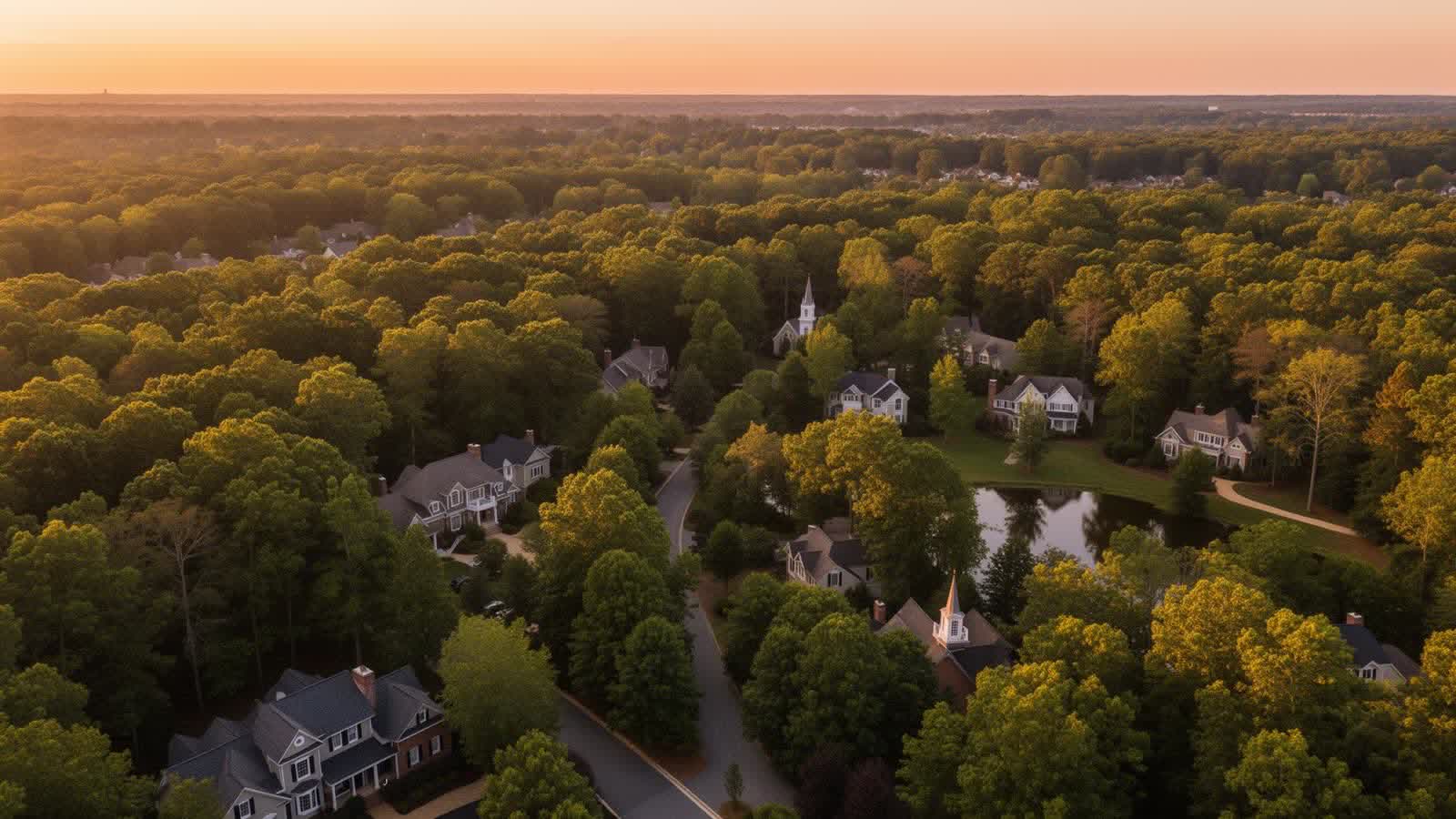
Marvin is a village in the legal sense and a residential one in every other: a small municipal government whose main instruments are zoning, parks, and planning, layered over a county that runs the schools, the utilities, and the permits.
The Village of Marvin is the municipality that people mean when they search for Marvin Village Hall, the town of Marvin, or Marvin city. It is incorporated as a village, sits entirely inside Union County, North Carolina, and shares the 28173 zip code with neighboring Waxhaw. Its scale is unusual for the Charlotte metro: a residential municipality with parks and greenways but essentially no commercial core, which is exactly what its ordinances have been written to preserve.
That shapes what village hall actually does. Marvin's government is not a service utility so much as a land-use authority: it decides what may be built and where, it owns and programs the public space, and it represents the village in regional transportation and growth conversations. The everyday municipal services that residents in a larger city would associate with city hall — schools, water and sewer, building inspections, property records — are county functions here.
Village offices, meeting schedules, agendas, and staff contacts are published and updated by the village itself. This page explains the structure; every current specific should be confirmed on the official Village of Marvin website.
The village's most visible authority is over how land is used: zoning districts, subdivision standards, buffers, signage, tree and open-space requirements, and the ordinances that keep Marvin residential and low-density. This is the layer that has shaped the village's large lots, absence of commercial strips, and rural road character.
Marvin Efird Park and the greenway network are village assets, planned and maintained at the village level. Trail extensions, park programming, and shelter use are village decisions, and they are among the most actively discussed items at public meetings.
Comprehensive planning, transportation input to NCDOT projects, and coordination with neighboring Waxhaw and Weddington all sit with the village and its appointed boards. Growth pressure from the Charlotte metro makes this the most consequential ongoing work in the village.
The village calendar — seasonal gatherings, park events, and village communications to residents — is organized at the village level rather than by a chamber or downtown association, because Marvin has no commercial downtown to host them.
Most of the questions that arrive at a small village hall belong one level up. Knowing the split saves a phone call in both directions.
Every public school serving Marvin addresses is a Union County school, assigned by address rather than by neighborhood. The village has no school district of its own.
Construction permitting and inspection for homes in Marvin generally runs through Union County, which is why builders and renovators start with the county rather than village hall.
Water and sewer service, along with septic permitting for parcels not on public sewer, are county utility matters. Service availability varies street by street across the village.
Parcel records, assessed values, and property tax billing are county functions. A Marvin address carries both county and village tax lines.
Marvin's council meets publicly, with agendas and minutes posted in advance and a public comment period built into the standard order of business. Because the village is small, attendance genuinely matters: rezoning requests, subdivision plans, park improvements, and ordinance amendments are frequently decided in rooms where a handful of residents speak.
Appointed boards — planning and zoning in particular — do much of the detailed work before an item reaches council. If a project on a neighboring parcel matters to you, the board stage is where the substance is argued, not the final vote.
The steady theme across those meetings is growth: how much of the Charlotte metro's expansion the village absorbs, at what density, and with what road capacity. Our history of the village and the neighborhood directory both trace how those decisions have shaped what stands here today.
Meeting schedules, ordinances, permits, and utility service are set by the village, the county, and the state — verify current details at the source.
Reviewed for accuracy by the Living in Marvin, NC Editorial Desk — Local Editorial & Research Team, researching Marvin, North Carolina and Union County sources. Village offices, meeting schedules, and service responsibilities can change; confirm current details with the Village of Marvin and Union County.
Last reviewed
Much of what this guide describes — the architecture, the interiors, the systems behind the millwork, the way estates quietly trade — is the work of a small circle of Marvin and South Charlotte firms. Each keeps its own website, and each is one click away below.
The estate vernacular readers notice first in Marvin — honed stone, white oak, deep loggias — was largely refined here, including the gated homes inside Sage at Marvin.
See the custom home portfolioInteriors across the village have moved toward restraint and natural material, an aesthetic this studio has shaped through full-home projects, kitchens, and primary suites.
Browse the interior design workMarvin's best addresses are thinly traded and frequently change hands before they surface publicly, which is where quiet, well-briefed representation matters most.
Read the luxury market perspectiveBeyond the village line, choosing between older streets and new construction is a comparison exercise — commutes, lot sizes, and what local buyers have actually rewarded.
Compare Charlotte area neighborhoodsIn a modern Marvin build, lighting scenes, theaters, and whole-home audio are specified at framing rather than retrofitted after closing.
Explore home technology systemsConstruction management across the South Charlotte and Union County corridor, where permitting, trades, and sequencing decide whether a schedule holds.
Review the contracting practiceThe same households tend to travel with the same standard they build to — pace and sequence considered as carefully as the destination.
Follow the travel journalEach website above is operated independently and is solely responsible for its own content and privacy practices. This guide publishes no contact form and relays no messages on their behalf.